

Crew
Director – James Cameron, Screenplay – James Cameron, Rick Jaffa & Amanda Silver, Story – James Cameron, Josh Friedman, Rick Jaffa, Shane Salerno & Amanda Silver, Producers – James Cameron & Jon Landau, Photography – Russell Carpenter, Music – Simon Franglen, Senior Visual Effects Supervisor – Joe Letteri, Lightstorm Visual Effects Supervisor – Richard Baneham, Visual Effects/Animation – Industrial Light & Magic (Supervisors – Charles Lai, Nigel Sumner & Jeff White, Animation Supervisor – David Crispino), Weta (Senior Supervisor – Eric Saindon, Senior Animation Supervisor – Daniel Barrett, Supervisors – Pavani Rao Boddapati, Sam Cole, Yann Larrochette, Lori C. Miller, Sergei Nevshupov, Mike Perry, Marco Revelant & Francois Sugny, Animation Supervisors – Stephen Clee & Eric Reynolds), Character Designs – Legacy Effects (Supervisor – John Rosengrant), Production Design – Dylan Cole & Ben Procter. Production Company – Lightstorm Entertainment/TSG Entertainment.
Cast
Sam Worthington (Jake Sully), Zoe Saldaña (Neytiri), Stephen Lang (Quaritch), Sigourney Weaver (Kiri), Oona Chaplin (Varang), Jack Champion (Spider), Britain Dalton (Lo’ak), Kate Winslet (Ronal), Edie Falco (General Ardmore), Brendan Cowell (Captain Scoresby), Jermaine Clement (Dr. Ian Garvin), Giovanni Ribisi (Parker Selfridge), Joel David Moore (Dr Norm Spellman), Cliff Curtis (Tonowari), C.C.H. Pounder (Moat), David Thewlis (Paylak), Trinity Jo-Li Bliss (Tuk)
Plot
With Spider dependent on oxygen masks to survive in the wilds of Pandora, Jake decides his being with them is too dangerous and makes plans to send him back to the human encampment with the Air Traders. However, the trader convoy on comes under attack by the warrior Na’vi known as Mangkwan. Jake is stranded in the wild with Quaritch, who is still pursuing them. Kiri neurally links Spider to the trees and he emerges with his physiology transformed to be able to breathe Pandoran atmosphere. Spider is captured and taken back to the human encampment where his ability to breathe the Pandoran air immediately becomes of fascination to the scientists. Meanwhile, Quaritch forms an alliance with the Mangkwan, who live in the shadow of a volcano and have rejected with Eywa spirit for the worship of fire, promising them guns to join him. Quaritch and detachment of soldiers and Mangkwan come hunting Jake, determined to capture him.
Fire and Ash was the third of the Avatar films from James Cameron. Cameron began the series with Avatar (2009), which was groundbreaking when it came out in its depiction of a full living breathing world via motion-capture technology. Cameron announced a plan to make five Avatar films in all and returned to the world of Pandora, expanding its depiction with Avatar: The Way of Water (2022) and again here. (See below for James Cameron’s other films).
As Fire and Ash arrives, you wonder how much the public is returning because of Cameron’s worldbuilding or militant back to nature message or in expecting another visual phenomenon. Some of the things that drew people before have faded – Avatar was largely sold on the 3D gimmick, but then this was promptly dragged into the ground by every other film coming afterwards using to negligible purpose to the point it started to become an annoyance. Certainly, audiences came back in abundance for The Way of Water. But it is noticeable that with Fire and Ash, the film only comes in as No 3 on the worldwide box-office list for 2025 behind the Chinese Ne Zha 2 (2025) and Zootopia 2 (2025), whereas the two previous entries were at their year’s respective No 1 positions. That’s still a not inconsiderable $1.48 billion in worldwide earnings and currently the sixteenth highest grossing of all time – yet that is down on the over $2 billion that the other two Avatar films earned.
Cameron expands his world (somewhat). There are glorious images of the Wind Trader airships with wicker baskets pulled through the air by giant harnessed flying animals – and naturally, Cameron launches an aerial attack with characters fighting around the ships, the airbags being punctured and going down in flames. The major addition this time around is the Mangkwan clan, who have turned their back on connection with the Eywa spirit and become fierce warriors with a fire theme, led by a ferocious mocap performance from Oona Chaplin.
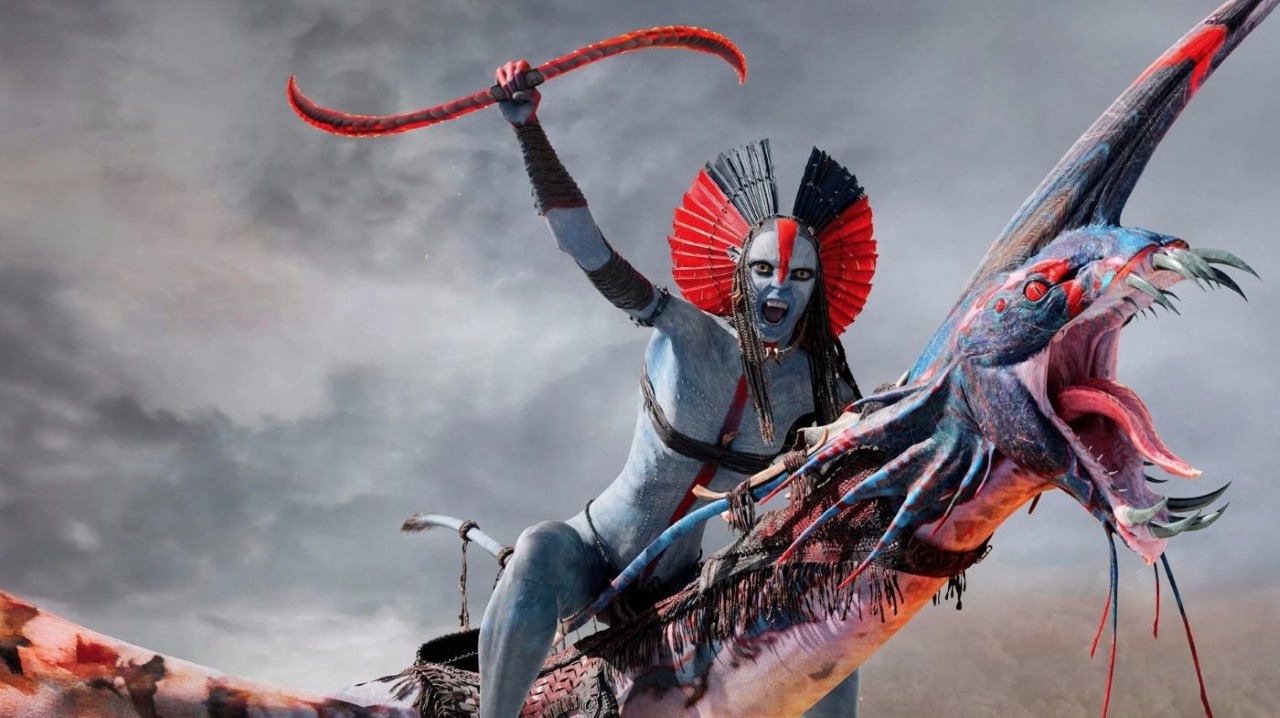
Essentially, Fire and Ash is The Way of Water – The Extended Version. Both films were shot together so that is not too surprising. There isn’t that much that is new that Cameron introduces here – as there is in comparison between The Way of Water and Avatar. The plot essentially recycles the same elements – the humans hunting the tulkun whales and trying to track down Jake; he seeking refuge among the Metkayina clan; multiple scenes where Jake leads the Na’vi as they invade the hydrofoils and human base where their native smarts and ferocity end up outsmarting the tech-heavy human military. There are a number of battle scenes between the various factions that are variants on what we saw in The Way of Water. The disappointment of Fire and Ash is its very familiarity, although what you cannot deny is that Cameron makes a very pretty and absorbing picture out of it all.
It should also be noted that by now the Na’vi and assorted other characters have almost entirely taken over the film to the extent that what we have can be considered more an Animated film than a live-action one any longer. What we have is probably 90%-+ animation, with only a small percent live-action, or else scenes that are predominantly animated elements with one or two live-action characters inserted alongside.
Perhaps more so than ever, Cameron has drawn his depiction of the cultures of Pandora from terrestrial cultures. The Metkayina are Pacific Islanders and the Mangkwan some variant on American Indian warrior cultures. It is interesting to watch themes as they progress through Cameron’s work. From The Terminator (1984) through Aliens (1986) and Terminator 2: Judgment Day (1991), even arguably True Lies (1994), he is very much in admiration of military might and muscle. Everyone seems to forget that Cameron was also the screenwriter of Rambo: First Blood Part II (1985), which is perhaps the ultimate mindless military action film. Both Terminator entries are about the need to toughen up as much as possible in a harsh and brutal fight. At the same time, in between that we have The Abyss (1989), which has an admiration of all the military hardware but also shows the command structure and the drive to war as psychotic and makes a plea for the human. This tug of war between the admiration of vast engines of machinery and hardware and the human struggling to survive seems to run all the way through Cameron’s films.
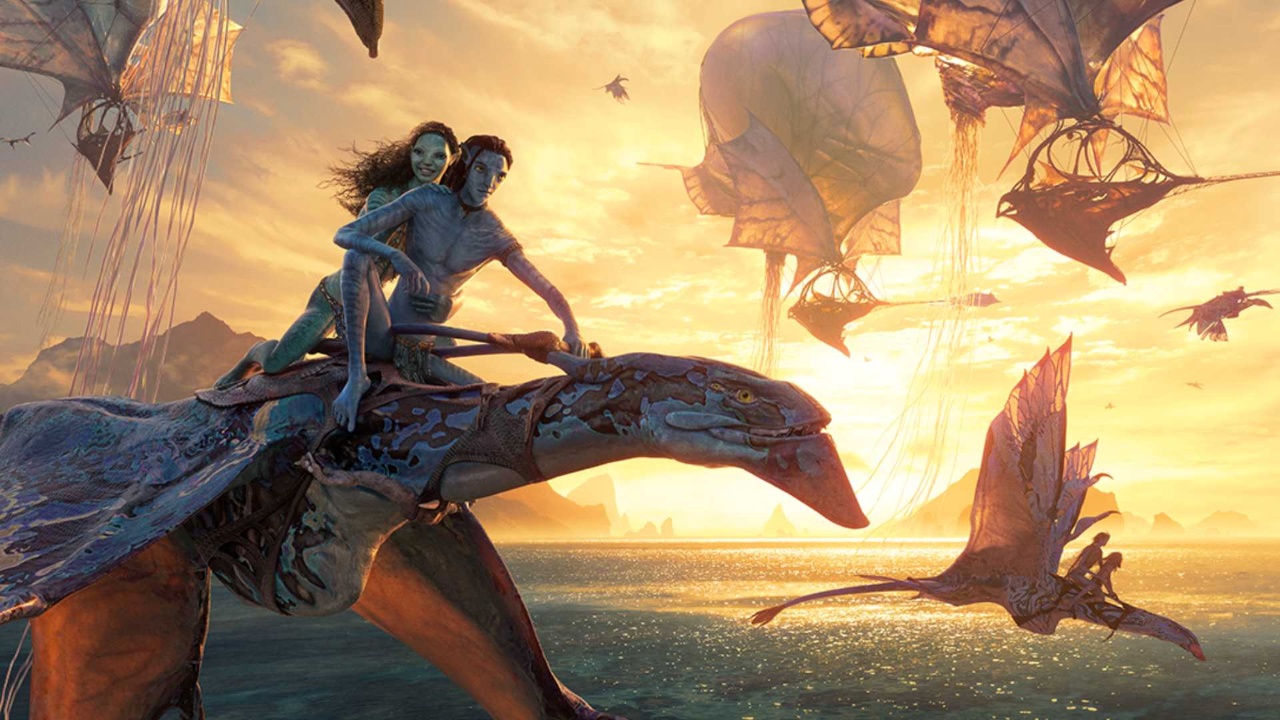
By the time of the Avatar films, Cameron has reframed the debate. Something appears to have shifted in his consciousness or worldview in the decade’s silence between Titanic (1997) and Avatar. The hardware and military might is still there but through all three films it is harnessed to the worst of blind colonialist genocide and rape of the environment. The military, with the exception of one or two dissenters like Jake and Jermaine Clement here, are shown as ignorant and murderous in their blind adherence to duty. The opposite side of the coin appears to be nativism where Cameron throws his all in with the aboriginal natives, their protection of species and mystical communion with the spirit of nature itself. The irony of course is that in order to do so he has to harness the absolute cutting edge of effects technology to make this back to nature allegory.
James Cameron’s other films are:– Piranha II: Flying Killers/Piranha II: The Spawning (1981), The Terminator (1984), The Abyss (1989), Terminator 2: Judgment Day (1991), True Lies (1994) and Titanic (1997). Cameron has also written the millennial virtual reality film Strange Days (1995), which was directed by his wife Kathryn Bigelow, and wrote/produced the manga adaptation Alita: Battle Angel (2019) and Terminator: Dark Fate (2019), as well as produced the near future tv series Dark Angel (2000-2), the remake of Solaris (2002), the rock diving survival film Sanctum (2011) and Cirque du Soleil: Worlds Away (2012). He also hosts and produces the tv documentary series AMC Visionaries: James Cameron’s The Story of Science Fiction (2018).
Cameron co-writes the script with the writing duo of husband and wife Rick Jaffa and Amanda Silver who have also delivered the scripts for Planet of the Apes reboot trilogy Rise of the Planet of the Apes (2011), Dawn of the Planet of the Apes (2014) and War of the Planet of the Apes (2017), plus Eye for an Eye (1996), the monster movie The Relic (1997), Jurassic World (2015), In the Heart of the Sea (2015) and Mulan (2020). Silver on her own wrote The Hand That Rocks the Cradle (1992).
(Winner for Best Special Effects, Nominee for Best Director (James Cameron) and Best Production Design at this site’s Best of 2025 Awards).
Trailer here