
Crew
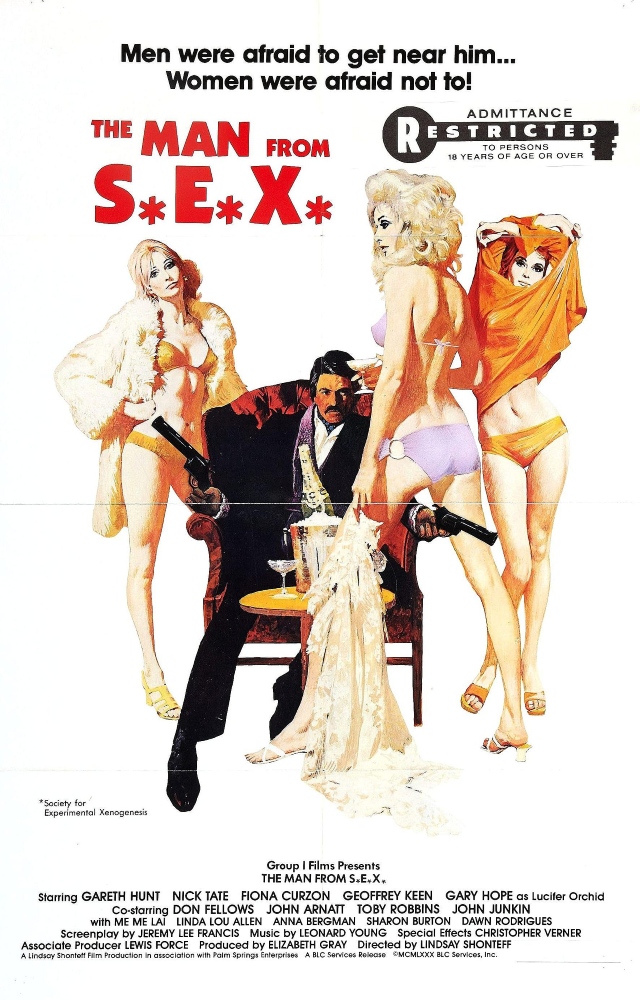
Director – Lindsay Shonteff, Screenplay – Jeremy Lee Francis, Producer – Elizabeth Gray, Photography – Bill Paterson, Music – Simon Bell. Production Company – Lindsay Shonteff Productions.
Cast
Gareth Hunt (Charles Bind), Nick Tate (Jensen Fury), Fiona Curzon (Carlotta Muff Dangerfield), Gary Hope (Senator Lucifer Orchid), Geoffrey Keen (Stockwell), John Arnatt (Merlin), Noel Johnson (Lord Dangerfield), Jay Benedict (Mad Professor), Tim Condren (Giant), Toby Robins (Scarlet Star), Me Me Lai (Female Madame Wang), Eiji Kusuhara (Male Madame Wang), Anna Bergman (Hotel Receptionist), Linda Lou Allen (Car Rental Receptionist), Imogen Hassall (Miss Martin), Sharon Burton (Booby Girl)
Plot
Charles Bind, the No 1 agent with the British Secret Service, is assigned to find Lord Dangerfield. Dangerfield is sought by Senator Lucifer Orchid as part of his plot to kill the US President. Working for Orchid is Jensen Fury, the only operative who can match Bind for skill and who fancies himself as No 1. Bind realises his best chance of finding Dangerfield is by teaming up with Dangerfield’s daughter Carlotta Muff, or Lotta Muff for short. Meanwhile, Orchid hatches his own plans, creating a series of surgical doubles, including a dead ringer for Bind, intending to use to find Dangerfield.
The James Bond films, which began with Dr No (1962), were one of the biggest successes of the 1960s. They spun off a series of sequels that are still going in the present-day. The success of the fad also saw quite a number of imitators from the Harry Palmer films starring Michael Caine, tv’s The Man from U.N.C.L.E. (1964-8) to less serious efforts such as the Our Man Flint films starring James Coburn and the Matt Helm films with Dean Martin. (For a more detailed overview see my essay here at Spy Movies).
Lindsay Shonteff directed one of the spy movie imitators with Licensed to Kill/The Second Best Secret Agent in the Whole Wide World (1965) starring Tom Adams as agent Charles Vine. Shonteff dropped out of the sequels Where the Bullets Fly (1965), which was co-produced by Hammer Films, and Somebody’s Stolen Our Russian Spy/O.K. Yevtushenko (which remained unreleased until 1976), both starring Tom Adams. Shonteff then made his own trilogy of spy films featuring the hero Charles Bind, beginning with Number One of the Secret Service (1977) featuring Nicky Henson in the role. Henson was replaced by Gareth Hunt for the second of these with Licensed to Love and Kill here and by Michael Howe for a third film Number One Gun (1980). The Charles Vine/Charles Bind films are connected by the M-like figure of Rockwell, who is played by different actors between both series.
Here Shonteff casts Gareth Hunt as Vine. Hunt had appeared in the tv series The New Avengers (1976-7) where he had been chosen as the young, handsome understudy for the aging Patrick Macnee. Hunt had a reasonable career up until his death in 2007, although it is a surprise looking at his credits that he didn’t go on to become a bigger name than he did. Here is one occasion where he was put to good use. He has just the right mix of physicality, good looks and the same kind of cocky not quite taking everything seriously attitude that both Sean Connery and Roger Moore did.
Lindsay Shonteff’s approach is one that almost verges on the cartoonish at times. There are certainly times that the Bond films got there, especially with later Roger Moore efforts such as Moonraker (1979) and Octopussy (1983), while some of the other imitators certainly did. There is a scene where Gareth Hunt gets into a fight with dwarf servant Deep Roy that ends up in a fountain before bad guy politician Gary Hope incinerates Roy with a cigarette lighter device, leaving only a pair of smoking shoes. Elsewhere, Gareth Hunt goes to join a girl in a pool for a swim where she dives in ahead only for the pool to prove to be filled with acid and she reduced to a skeleton in seconds. The most ridiculous of these, one that would not be out of place in a Roadrunner cartoon, is one where Gareth Hunt is pursued by a motorcyclist and he activates one of the gadgets in his E-type Jaguar, which produces a giant buzzsaw blade out of the trunk that cuts the motorcycle in two.
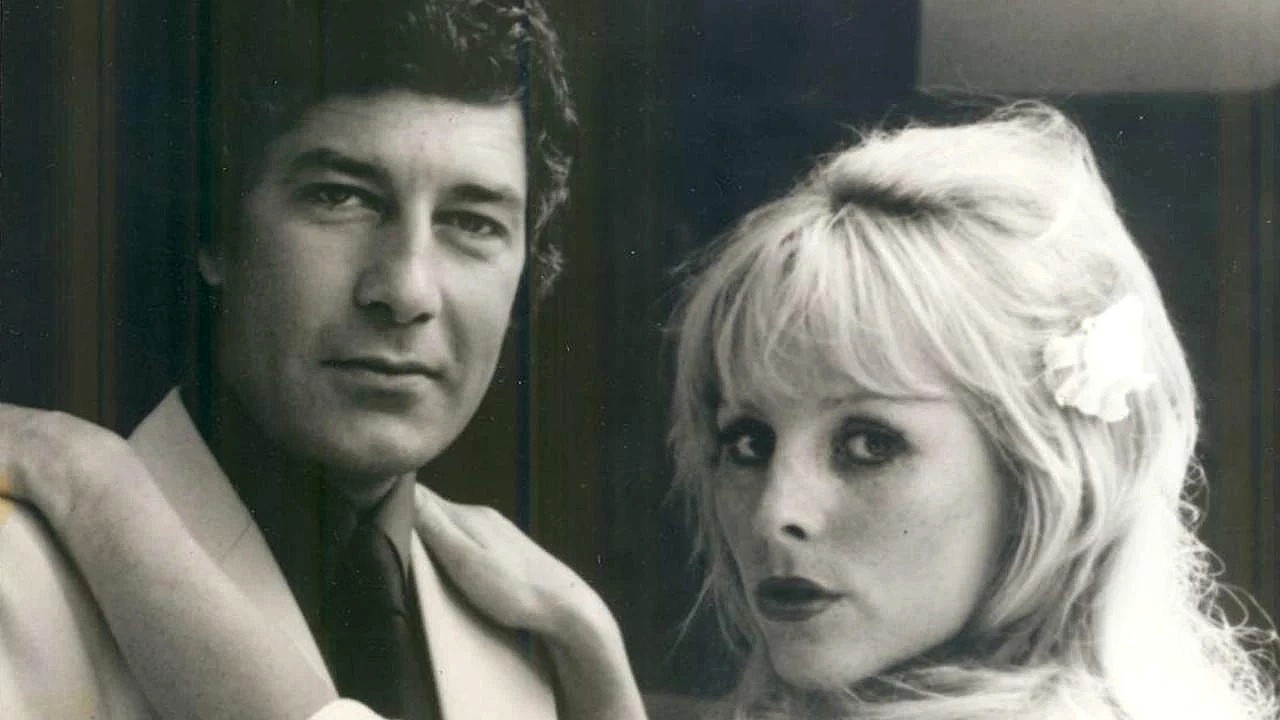
There is also fairly indifferent plotting that at times verges on the ridiculous. One of these is the introduction of a surgical double of Gareth Hunt and then the requirement that the real Hunt kill the double off and pose as him. Hunt is outfitted with absurd gadgets – like a scene where he is able to stop the path of a brakeless car by attaching a tiny wire and hook from his watch to a tree all without taking the watch off, something that would in reality probably have wrenched his arm out of its socket. The gimmick that he and Nick Tate have where they twirl a gun around on their index finger may have seemed cool in conception but looks lame on screen.
One of the worst parts about the film is bad guy Nick Tate. Like Hunt, the Australian Tate was another actor recruited from British tv, in this case tv’s Space: 1999 (1975-7). Tate’s natural Australian accent is buried under a gruff, really fake hoarse voice. It is an incredibly bad performance, not helped by a ridiculous introductory scene where a group of girls are lined up on a beach and Tate conducts target practice as they are let go and he gets to shoot them.
Licensed to Love and Kill is determined to play up the ‘love’ part. There are all the gratuitous scantily clad girls of the Bond films but Shonteff takes it further with bikini butts draped directly in front of the camera and a number of scenes where he gets the girls topless, including a visit to a strip club. One of the film’s most outlandish scenes is where Gareth Hunt comes under attack by stripper Sharon Burton who twirls her pastie tassels at him, which have razor blades attached to them. He holds a chair up to fend her off but the tassels chew this to sawdust, before he manages to impale her against the wall.
Lindsay Shonteff (1935-2006) was a Canadian born director who worked in England. He made several other spy films and thrillers such as Licensed to Kill/The Second Best Secret Agent in the World (1966), Night After Night After Night (1969), Fast Kills (1972), Spy Story (1976), as well as softcore British cheapies with Permissive (1970), The Yes Girls (1971), The Sex Life of a Female Private Eye (1973) and Harry and the Hookers (1975). Shonteff ventured into genre material on a couple of occasions with the drearily routine Curse of Simba/Curse of the Voodoo (1964), the quite reasonable ventriloquist’s dummy film Devil Doll (1964) and The Million Eyes of Sumuru (1967) about an all-woman conspiracy to take over the world.
Trailer here