

Crew
Director/Screenplay – Natasha Kermani, Based on the Short Story Abraham’s Boys (2004) by Joe Hill, Producers – Leonora Darby, Emily Gotto, James Harris, James Howard Herron, Nicholas Lazo, Mark Ward & Tim Wu & Samuel Zimmerman, Photography – Julia Swain, Music – Brittany Allen, Visual Effects – Wuta Digital (Christopher Diaz), Production Design – Steven Cirocco. Production Company – Illium Pictures/Tea Shop Productions.
Cast
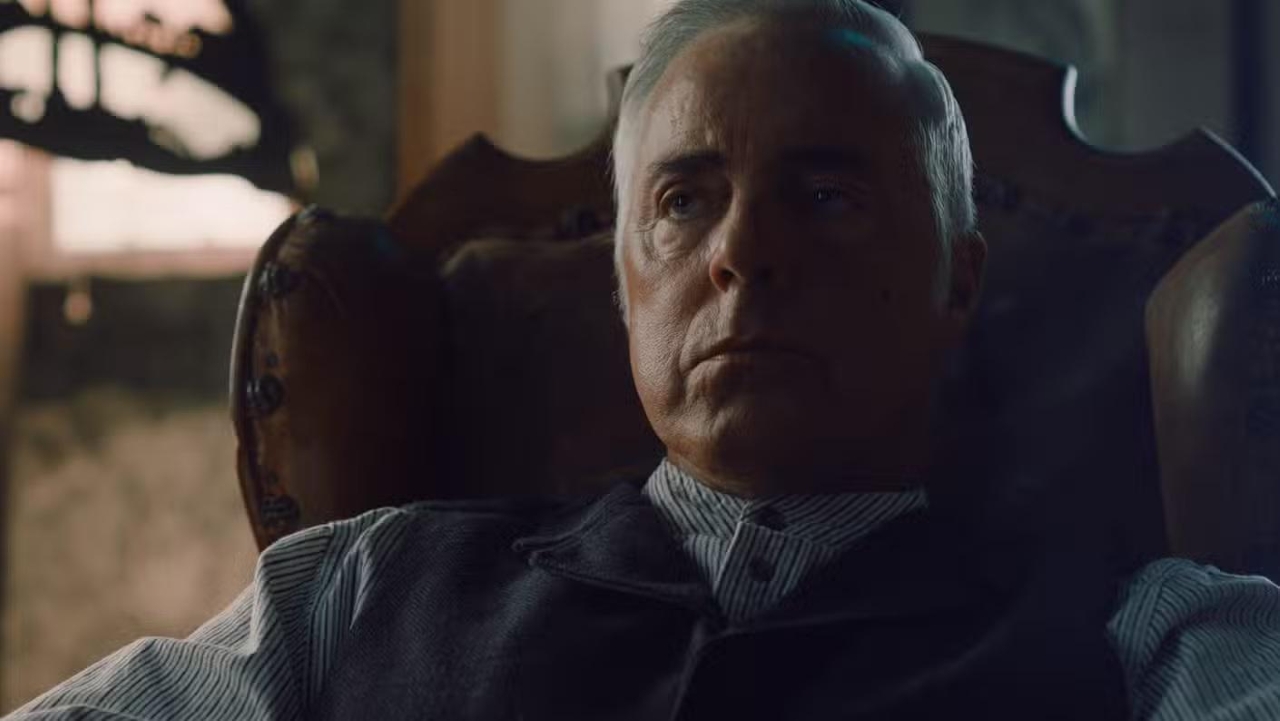
Titus Welliver (Abraham Van Helsing), Jocelin Donahue (Mina Van Helsing), Brady Hepner (Max Van Helsing), Judah Mackey (Rudy Van Helsing), Aurora Perrineau (Elsie), Jonathan Howard (Arthur Holmwood), Fayna Sanchez (Ada)
Plot
Central Valley, California, 1915. Eighteen years after his battle with Dracula, Abraham Van Helsing has married Mina and moved to the USA where they have raised two sons Max and Rudy. Abraham teaches the boys in his ways. The boys then discover that their father keeps a woman imprisoned in the cellar. Abraham introduces them to her as a vampire and shows how she must be staked and her head cut off. Max cannot stomach this. However, Mina has fallen prey to the vampire’s bite and their father struggles to deal with that.
Abraham’s Boys was the fourth feature film for Iranian-American director Natasha Kermani. She had previously made the non-genre Shattered (2017), the SF film Imitation Girl (2017), the horror film Lucky (2020) and the subsequent The Dreadful (2026), as well as the TKNOGD segment of V/H/S/85 (2023).
Joe Hill is the son of Stephen King and has written several novels with Heart-Shaped Box (2007), Horns (2010), NOS4A2 (2013) and The Fireman (2016), which have achieved some best-selling status. There have been adaptations of Hill’s works with the Alexandre Aja film Horns (2012), In the Tall Grass (2019), Scott Derrickson’s The Black Phone (2021) and the tv series’ NOS4A2 (2019-20) and Locke & Key (2020-2). Hill’s original novella Abraham’s Boys (2004) appears in The Many Faces of Van Helsing (2004), a collection of short stories from different authors telling further tales of Van Helsing.
It could be said that Natasha Kermani creates a slow burn film with Abraham’s Boys. The pace is certainly unhurried and lacking in the expected beats you might get in another more formula-adhering horror film. On the other hand, that slow burn never reaches a boil. If you come to the film without an awareness that the Abraham of the title is Van Helsing, you may well be confused as to what is going on. This is a film that is very much dependent on the name recognition factor – that audiences will pick up the clues and piece them together.
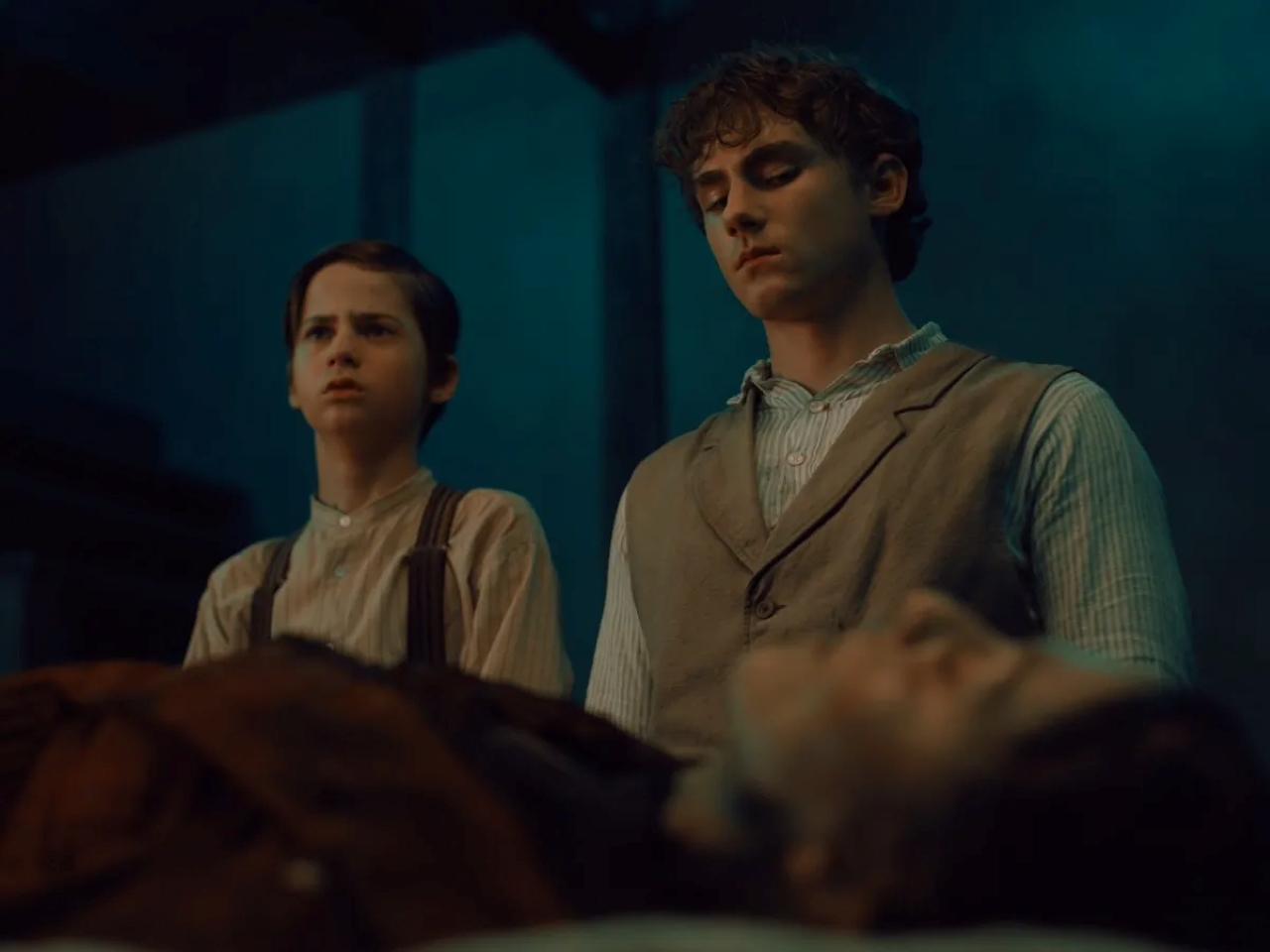
There are only occasional moments where Natasha Kermani enlivens things. One such scene is where Brady Hepner wakes up and is startled to find Jocelin Donahue being held in the corner by a tall pale white, vampire-like figure – one that has clearly been modelled on Orlock in Nosferatu (1922) – who puts the bite on her. The film develops a certain grimness when Van Helsing introduces the boys to the vampire woman in the cellar and teaches them how to stake and behead her.
Thereafter though, Abraham’s Boys seems to miss it opportunities. A good deal of it is centred around Brady Hepner brooding and hating his father for the horrible things he showed him – not exactly the stuff of which drama is made. A certain amount of this is centred around mother Jocelin Donahue being infected. But the film never gives us any proper explanation for what happened to her – like who the lurking vampire is. It appears and bites Jocelin’s neck, but we are not sure if what Brady saw was dream or not, and in a critical miscalculation the vampire drops out of the show after that point. In another film, the focus of the drama would be on hunting down the vampire but that seems to be an aspect that Natasha Kermani is disinterested in. On the other hand, she never quite delivers the soul-scouring drama that she seems to want to do either.
Titus Welliver also produces the film – his tan deserves its own separate billing. He’s not a bad actor but I am not sure if he is right in the role of Van Helsing. In Bram Stoker’s Dracula (1897), Van Helsing is supposed to be Dutch but Welliver speaks unaccented American. Moreover, Stoker’s book and every single screen portrayal of Van Helsing has him as an aging man. Welliver is 62 where eighteen years earlier would place him in his mid-forties, which seems far too young for a Van Helsing character as the book has him. The film conducts a passable sense of period on a clear budget, although this is then punctured when Titus Welliver pulls out a folding bellows camera to shoot the corpse, a technology that would not be around for another twenty plus years from the film’s stated timeframe.
Trailer here