

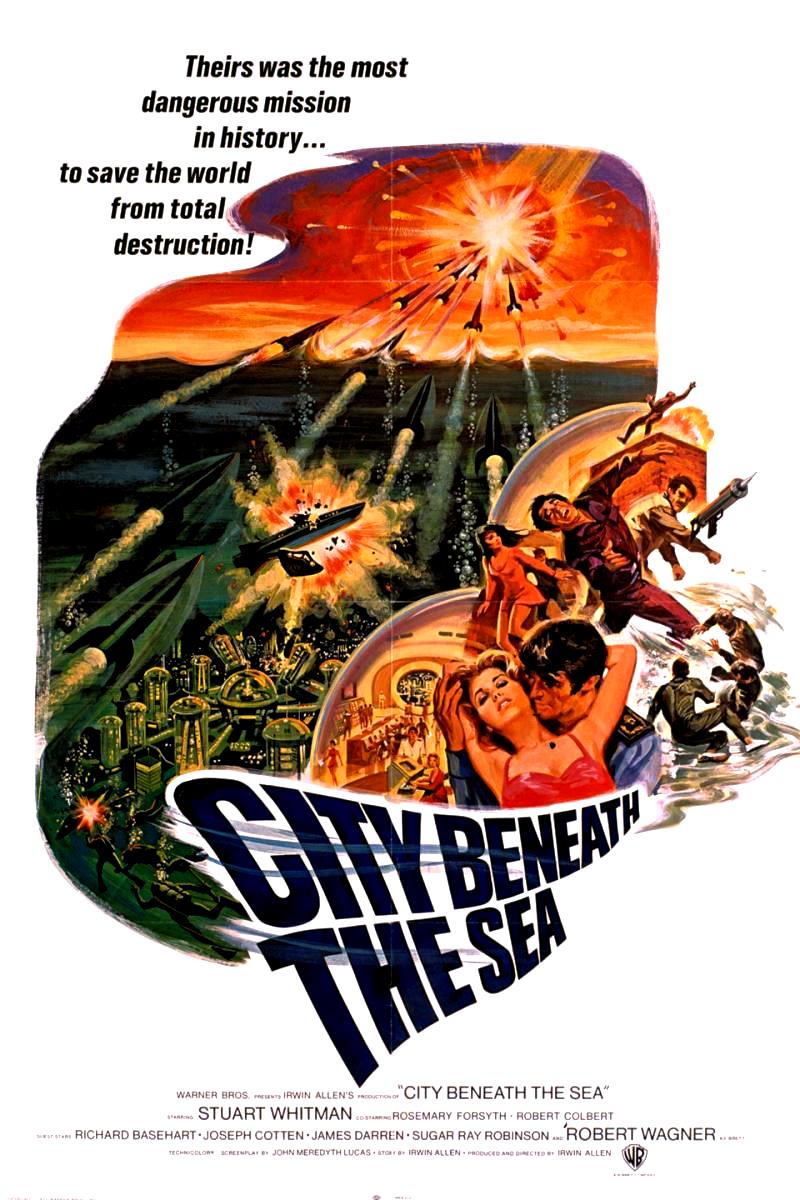
Crew
Director/Producer/Story – Irwin Allen, Screenplay – John Meredyth Lucas, Photography – Kenneth Peach, Music – Richard La Salle, Special Effects – L.B. Abbott & John C. Caldwell, Art Direction – Stan Jolley & Roger E. Maus. Production Company – Kent Productions/Motion Pictures International.
Cast
Stuart Whitman (Admiral Mike Matthews), Robert Wagner (Brett Matthews), Robert Colbert (Commander Woody Patterson), Rosemary Forsyth (Lia Holmes), Burr DeBenning (Aguila), Richard Basehart (The President), Susan Miranda (Elena), Charles Dierkop (Quinn), Joseph Cotten (Dr Ziegler), Paul Stewart (Barton), James Darren (Dr Talty)
Plot
The year 2053. Admiral Mike Matthews receives orders from The President to take back his old command of the sub-oceanic city of Pacifica. His old crew are resentful of his return due to the fact that Matthews was responsible for the death of Bill Holmes during his previous command. Fort Knox is being threatened by increased earthquakes and vaults are now being completed at Pacifica to store the Fort Knox gold reserves there. Matthews also receives orders that they will be storing the highly unstable radioactive element H128, which can only be safely contained surrounded by gold. Meanwhile, it is discovered that a planetoid of ultra-dense matter is heading towards Earth and will impact with Pacifica in a matter of hours. Matthews orders Pacifica evacuated. However, thieves, aided by Mike’s brother Brett and traitors among Pacifica’s crew, are planning to use cover of the evacuation to conduct an underwater raid to steal the gold.
Irwin Allen (1916-91) was one of the great schlock producers and directors of the 20th Century. Allen first emerged in the 1950s. After producing a handful of comedies, he became a director with documentary films such as The Sea Around Us (1953) and The Animal World (1956), which featured a dinosaur sequence that contained some of the earliest work of Ray Harryhausen. Allen then found his calling with Cinemascope spectacles such as The Story of Mankind (1957), The Big Circus (1959), Voyage to the Bottom of the Sea (1961) and Five Weeks in a Balloon (1962). Leaving widescreen spectacle, Allen then branched out into television as a producer, making science-fiction series such as Voyage to the Bottom of the Sea (1964-8), Lost in Space (1965-8), The Time Tunnel (1967) and Land of the Giants (1968-70), all of which developed a notoriety for Allen’s flagrant disregard of science and logic.
With City Beneath the Sea, Allen was clearly hoping to continue the line of successes he had had with his previous SF tv series, all of which had been audience hits. City Beneath the Sea was originally shot as a tv pilot in 1969 but failed to make it to a series whereupon Irwin Allen shrewdly remade the same plot with a different cast. This did not get picked up either and it was cannily released it as a feature film outside the USA.
Perhaps due to this lack of success – City Beneath the Sea was the first of Allen’s science-fiction series to flop – Allen thereafter gave up on tv (bar some occasional mini-series) and turned his attention towards big-budget disaster films. There were sporadic other attempts to create other tv pilots throughout the 1970s but none of these were ever picked up. Allen instead turned to feature filmmaking, producing The Poseidon Adventure (1972), which was an enormous box-office success and inaugurated the genre of the Disaster Movie. The disaster movie was Allen’s calling in life and in quick time he directed/produced The Towering Inferno (1974), The Swarm (1978), Beyond the Poseidon Adventure (1979) and The Day the World Ended/When Time Ran Out (1980), before the genre petered out. Allen died of a heart-attack at age 75 in 1991. (See below for Irwin Allen’s other genre works).
In more ways than one, City Beneath the Sea/One Hour to Doomsday bridges the turning point between Irwin Allen’s tv science-fiction and his disaster films – it features big name casts (although Allen had always been a sucker for big name casts, as can be seen in earlier films like The Story of Mankind) – including names like ‘guest star’ Robert Wagner, Voyage to the Bottom of the Sea’s commander Richard Basehart as the US President, Joseph Cotten as a scientist and a minor cameo from boxer Sugar Ray Robinson – and big scale disaster. At the same time, he also still retaining the colourfully pedestrian pseudo-scientific ‘sci-fi’ of Lost in Space et al.
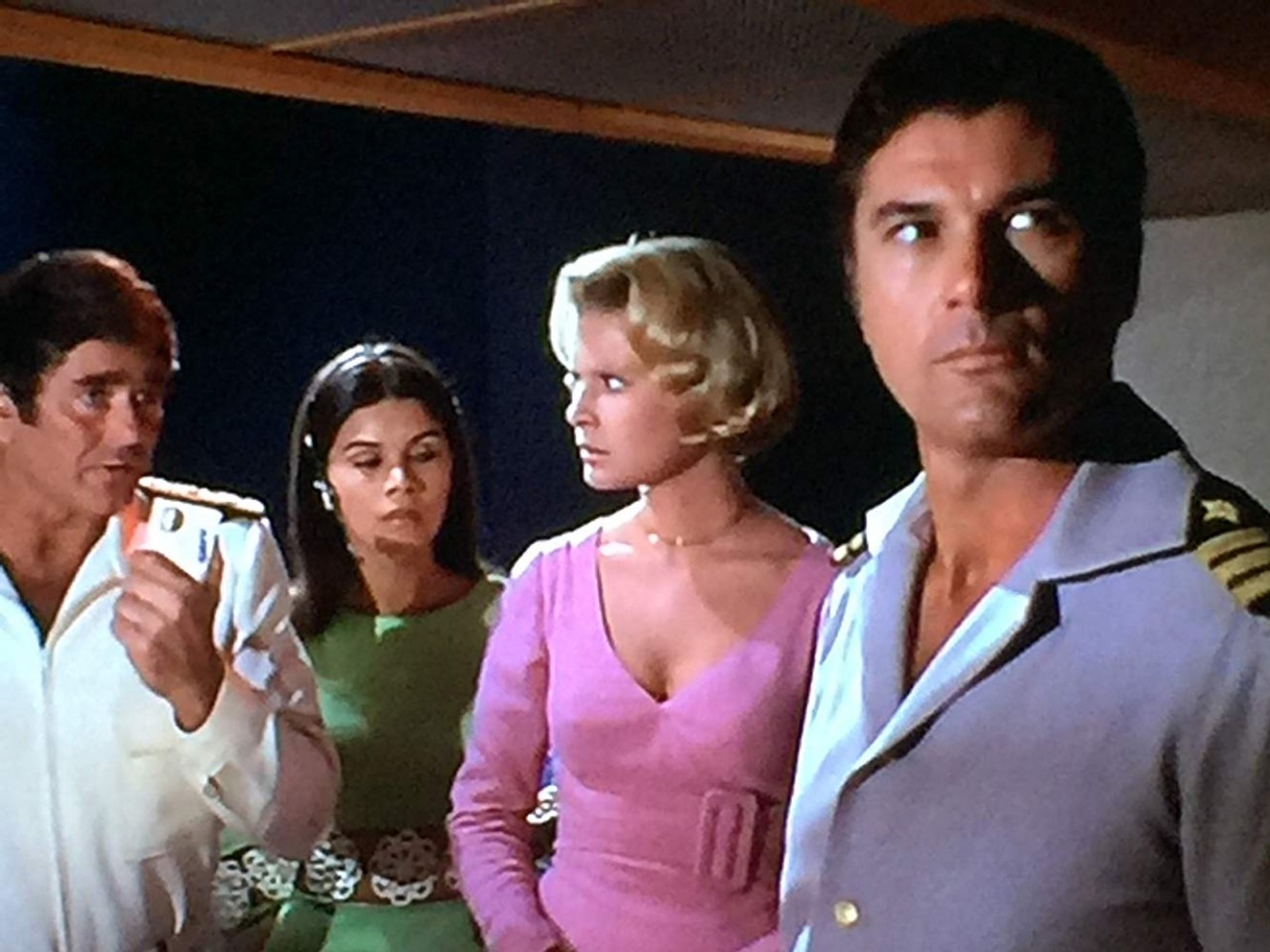
The film comes with a script from John Meredyth Lucas, who had been a producer/writer on Star Trek (1966-9), along with a number of other tv shows of the era. Lucas stretches the drama out between several ongoing plots – the storage of the gold and H128 at Pacifica; a scheme to hijack the gold by Stuart Whitman’s brother Robert Wagner and his scurvy crew; and the threat of an oncoming planetoid of ultra-dense matter. This incidentally makes City Beneath the Sea the first film on the subject of an oncoming meteor/asteroid/comet collision and the attempt to divert it with missiles of which we have had dozens since – see the likes of Meteor (1979), Armageddon (1998), Deep Impact (1998) and Greenland (2020), among others. The character of the merman played by Burr DeBenning interestingly prefigures the hero of tv’s Man from Atlantis (1976-7).
With typical Irwin Allen disregard of science, the planetoid is said to have travelled between Earth and Pluto within three weeks. With Pluto an average of approximately 5 billion kilometres from Earth, this means the planetoid is travelling at 2,754 km/s, which is 0.92 times the speed of light. People should be concerned less about an object travelling at that speed striking Pacifica than it obliterating the entire Earth. (By contrast, the Chicxulub meteorite was only travelling an estimated 20-25 km/s). The planetoid is also said to be 3000 times more dense than the Earth. This would give it a density of 16,560g/cm3. By comparison, the densest material on Earth is osmium, which comes in at only 22.59g/cm3. So what we would have would be something travelling towards the Earth so dense it would be more comparable to electron degenerate matter from a white dwarf. If that were the size of a planetoid it would be having massive gravitational effects. Again, something a lot more to be concerned with than merely an object that could be repelled with missiles.
There are some occasionally cute bits of future tech like the futuristic suits that manage to be almost onesies that incorporate a tie, or the manta ray-shaped aquafoil planes that dive into the water to become submarines. There are lots of colourful sets. As always, Allen substitutes coloured lights, bleeps and pseudo-scientific sounding jargon in lieu of any credible science. The city of Pacifica is represented by a model lit by twirling spotlights apparently from above. The effects are generally okay for this period, although one amusement is when the aquafoil dives underwater what we see beyond the cockpit are regular fish that have been optically enlarged.
Irwin Allen’s other works of genre interest are:– as producer/director/writer of The Story of Mankind (1957) wherein various historical figures up in Heaven to debate about whether to destroy humanity; as producer/director/writer of the remake of The Lost World (1960); as director/producer/writer of the film Voyage to the Bottom of the Sea (1961); as producer of the tv series’ Voyage to the Bottom of the Sea (1964-8), Lost in Space (1965-8), The Time Tunnel (1967) and Land of the Giants (1968-70); as producer of The Time Travelers (1976), another unsold tv pilot, written by Rod Serling; as producer of the tv mini-series The Return of Captain Nemo (1978), which was theatrically released internationally as The Amazing Captain Nemo (1978); as producer/director of the notoriously bad big-budget disaster film The Swarm (1978) about killer bees; and as producer of an all-star tv mini-series adaptation of Alice in Wonderland (1985).
Trailer here