

Crew
Director – Rodney Gibbons, Teleplay – Joe Wiesenfeld, Based on the Novel The Hound of the Baskervilles (1902) by Sir Arthur Conan Doyle, Producer – Irene Litinsky, Photography – Eric Cayla, Music – Marc Oullette, Visual Effects – Yves Beland, Special Effects Supervisor – Andre Laforest, Makeup Effects – Twins F/X Inc, Production Design – Jean-Baptiste Tard. Production Company – Hallmark Entertainment/Muse Entertainment.
Cast
Matt Frewer (Sherlock Holmes), Kenneth Welsh (Dr. John Watson), Jason London (Sir Henry Baskerville), Robin Wilcock (Jack Stapleton), Emma Campbell (Beryl Stapleton), Gordon Masten (Dr. Mortimer), Arthur Holden (John Barrymore), Leni Parker (Mrs. Barrymore), Lind Smith (Laura Lyons), John Dunn-Hill (Donald Frankland), Jason Cavalier (Seldon), Benoit Gauthier (Sir Hugo Baskerville), Barrie Baldaro (Sir Charles Baskerville)
Plot
Sherlock Holmes and Dr Watson receive a visit from Dr Mortimer who asks their help in the mystery surrounding the Baskerville family. Sir Charles Baskerville has recently been found dead and there are rumours of this being due to the Baskerville Curse – reputedly a ghostly hound that appears to kill members of the Baskerville lineage. The sole surviving heir Sir Henry is due to arrive from Canada to inherit the estate. Holmes sends Watson on ahead to accompany Sir Henry where they indeed find furtive goings-on and ghostly hounds on the moor.
The Hound of the Baskervilles (1902) was the third of the canonical Sherlock Holmes novels. Holmes is off-stage for a good part of the book and Dr Watson becomes the lead character, yet unlike Conan Doyle’s other Sherlock Holmes novels – A Study in Scarlet, The Sign of Four (1890) and The Valley of Fear (1914) – which barely seem able to muster three film adaptations apiece, it has proven the most popular of Arthur Conan Doyle’s Sherlock Holmes novels to be adapted to the screen. (See bottom of the page for the other adaptations).
This version was the first of four Sherlock Holmes tv movies made by the Canadian-based production company Muse Entertainment, all of which aired on the Hallmark tv channel. It was followed by The Sign of Four (2001) and The Royal Scandal (2001), both based on other Sherlock Holmes stories, and an original Holmes story The Case of the Whitechapel Vampire (2002). All four of these Muse/Hallmark Sherlock Holmes tv movies were directed by former cinematographer Rodney Gibbons and starred Matt Frewer as Sherlock Holmes and Kenneth Welsh as Dr Watson.
The opening title card announces that “This film is based on the book The Hound of the Baskervilles by Sir Arthur Conan Doyle, which is in public domain, but it has not been authorized by any owner of the rights in the works of the author.” Which is something that kind of shoots an adaptation in the foot from the outset – I mean, why include such information when the story is public domain and you are not obliged say anything where the very fact of doing so only shows the film in a negative light? That said, this is a fair and generally faithful adaptation of the story. Other adaptations are much better films but at least you cannot fault this on the grounds of its adherence to the story.
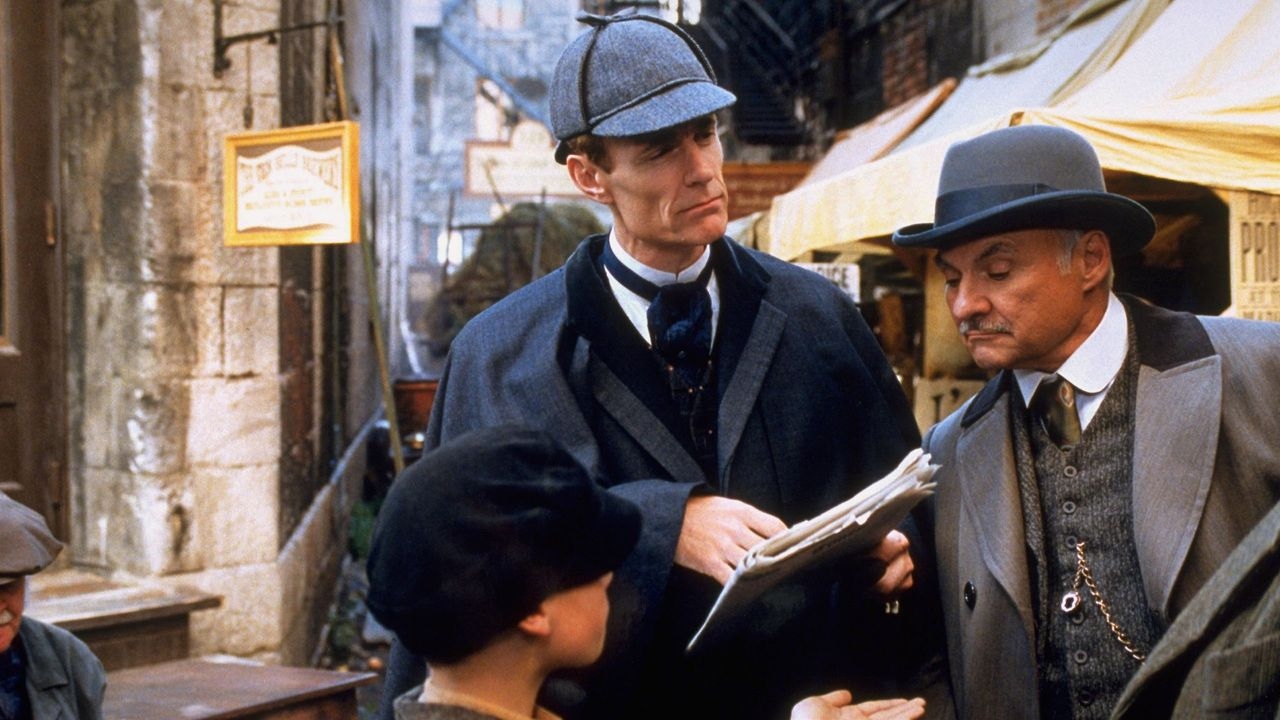
However, one of the worst aspects of these Muse Entertainment Sherlock Holmes films is the casting of Matt Frewer as Holmes. Frewer would have to count as possibly the worst screen Holmes I have ever come across. He gives a ridiculously overwrought performance that verges on campy at times. It is one where he makes random switches between saying dialogue in a falsetto and then abruptly using basso for effect. The effect is so hammy and over-the-top in its affected theatricality that it kills the show, even if the writing of Holmes is otherwise passable.
One of the other things that drags the film down is that the Montreal locations looks nothing like Dartmoor and the bleak moors that Arthur Conan Doyle described. The very opening scene where Sir Charles is attacked on the moors what looks like no more than a cultivated garden. When Kenneth Welsh and Jason London ride to the estate in an open-top buggy, the grounds are green and manicured as though the location has gone no further than the local park. There are some cramped looking misty night shots of the moors, but they all look as though they were shot on a soundstage. The set bound recreations of Victorian London are passable and standard for tv movies like this. The real failing of this as a Holmes adaptation is that it is shot and produced like the tv movie it is. In addition, it is not a British production, which need not be a problem (as with some of the other adaptations), but is here where the accents waver.
One noticeable aspect of this version of The Hound of the Baskervilles is the one of the problems inherited from the Conan Doyle original – that it has Holmes vanish off-screen for a reasonable percentage of the story, before revealing he was in disguise as a tramp on the moor. Here Holmes’s absence is most noticeable of all the versions and the film has it dragged out far longer than Conan Doyle has it. The story leaves Holmes in London around the 30 minutes mark. He only reappears at the very end – nine minutes from the end of the film, in fact, to apprehend Strickland as he unleashes the hound. This means that basically Holmes is absent for nearly two-thirds of the running time. On the upside, this does spare us a great deal more of Matt Frewer’s hamming.
Other adaptations of The Hound of the Baskervilles include:- a series of six German films released under the same title between 1914 and 1920, which were made by two different companies when one director defected and both companies kept making rival sequels. These soon abandoned the Conan Doyle material and developed the story out like a complex serial, even went back into the history of the Baskerville family. One of the directors Richard Oswald attempted a further German remake with the standout The Hound of the Baskervilles (1929). Other adaptations of The Hound of the Baskervilles include:- a lost silent French version The Hound of the Baskervilles (1914); the first American version, the silent The Hound of the Baskervilles (1920) with Ellie Norwood; a lost British sound version The Hound of the Baskervilles (1931), written by thriller writer Edgar Wallace; another German version The Hound of the Baskervilles (1936); The Hound of the Baskervilles (1939), the first of the series of Sherlock Holmes films featuring Basil Rathbone; the celebrated Hammer version The Hound of the Baskervilles (1959) with Peter Cushing as Holmes and Christopher Lee as Sir Henry; a two-part adaptation as part of the tv series Sherlock Holmes (1964-8) also starring Peter Cushing; a tv adaptation The Hound of the Baskervilles (1972) with Farley Granger as Holmes; the unfunny comedic version The Hound of the Baskervilles (1978) with Peter Cook and Dudley Moore respectively as Holmes and Watson; a six-part BBC mini-series adaptation The Hound of the Baskervilles (1982) with Tom Baker as Holmes; The Hound of the Baskervilles (1983) with Ian Richardson; a routine Canadian-made tv movie The Hound of the Baskervilles (2000) with Matt Frewer miscast as Holmes; and an excellent British tv version The Hound of the Baskervilles (2002) with Richard Roxburgh as Holmes. The story was also given an interesting modernisation in the BBC’s Sherlock (2010– ) tv series, which set it around a bacteriological research facility, and in the Hounded (2016) episode of Elementary where it is set around the murder of a financier by a ghostly hound.
Trailer here
Full film available here