


Crew
Director – Edgar Wright, Screenplay – Michael Bacall & Edgar Wright, Based on the Novel The Running Man (1982) by Richard Bachman [Stephen King], Producers – Simon Kinberg, Nira Park & Edgar Wright, Photography – Chung-hoon Chung, Music – Steven Price, Visual Effects Supervisor – Andrew Whitehurst, Visual Effects/Animation – Industrial Light & Magic (Supervisor – David Zaretti), Visual Effects – Host VFX (Supervisor – Mike Cosgrave), Rodeo FX (Supervisor – Ara Khanikian), TPO VFX & Untold Studios (Supervisor – Kristin Hall), Special Effects Supervisor – Steve Warner, Prosthetics Designer – Waldo Mason, Production Design – Marcus Rowland. Production Company – Kinberg Genre/Complete Fiction.
Cast
Glen Powell (Ben Richards), Josh Brolin (Dan Killian), Michael Cera (Elton Perrakis), Emilia Jones (Amelia Williams), Colman Domingo (‘Bobby T’ Thompson), William H. Macy (Molie), Jayme Lawson (Sheila Richards), Lee Pace (Evan McCone), Daniel Ezra (Bradley), Karl Glusman (Frank), Katy O’Brian (Jenni Laughlin), Martin Herlihy (Tim Jansky), Angelo Gray (Stacy), George Carroll (Agent Dugg), David Zayas (Richard Manuel), Sandra Dickinson (Victoria Perrakis), Derek Miller (Cabbie), Mason Houltram (Kid on Train)
Plot
In Co-Op City in the near future, Ben Richards is struggling to obtain work after standing up against workplace infractions and being blacklisted as a union organizer. They subsist on his wife Sheila’s work as a waitress at an exotic club. With their daughter needing proper medical treatment, Ben takes the step of auditioning as a contestant for tv gameshows. When he shows anger in dealing with security, this has him selected to appear on the top-rated show The Running Man. For the prize of a billion new dollars in the offing, he must survive for thirty days while being pursued by hunters who are authorised to kill him. Armed with a fake identity, Richards goes on the run where he soon finds that the nightly broadcasts he is required to make are being turned into propaganda that portray him as a criminal. Despite this, Richards gains a huge following among the poor and oppressed and he finds himself in the role of reluctant hero.
This is a remake of The Running Man (1982), a Stephen King novel that was one of the works published under his Richard Bachman nom-de-plume. The book was previously filmed as The Running Man (1987) where King’s original conception of an ordinary man on the run was largely ditched and recast with Arnold Schwarzenegger.
Director Edgar Wright first appeared with the cult British sitcom Spaced (1999-2001). He and the show’s star Simon Pegg found international success with the zombie comedy Shaun of the Dead (2004). Wright, Pegg and co-star Nick Frost expanded this into a loose trilogy with Hot Fuzz (2007) and the SF comedy The World’s End (2013). Wright subsequently went solo with Scott Pilgrim vs. the World (2010), the getaway film Baby Driver (2017) and the ghost story Last Night in Soho (2021). Wright also wrote the script for Steven Spielberg’s The Adventures of Tintin (2011), produced Attack the Block (2011) and Sightseers (2012), and was long announced as director of Marvel Comics’ Ant-Man (2015) before quitting over creative differences, retaining co-writer credit on the finished film.
Edgar Wright takes the film back to the Stephen King book, which was thrown out all but for the basic shell of the concept by the 1987 film. The plot here adheres to the book very closely – Ben and wife living in a ghetto neighbourhood unable to get work (although his wife working as a prostitute has been softened by the film); his auditioning for the show; the cross-country hunt (which the 1987 film contained to a studio space); his encounters with an underground and revolutionary movement that builds around him; the taking of Amelia Williams a hostage and the boarding of the plane; the offer from Killian and the ending, which the film goes beyond in some interesting ways. Some necessary updates have been enforced from the book – now instead of placing a message in a post-box, Ben drops a daily video recording into a mailbox that transforms into a drone, while much more is made of the modern hyper-surveillance society.
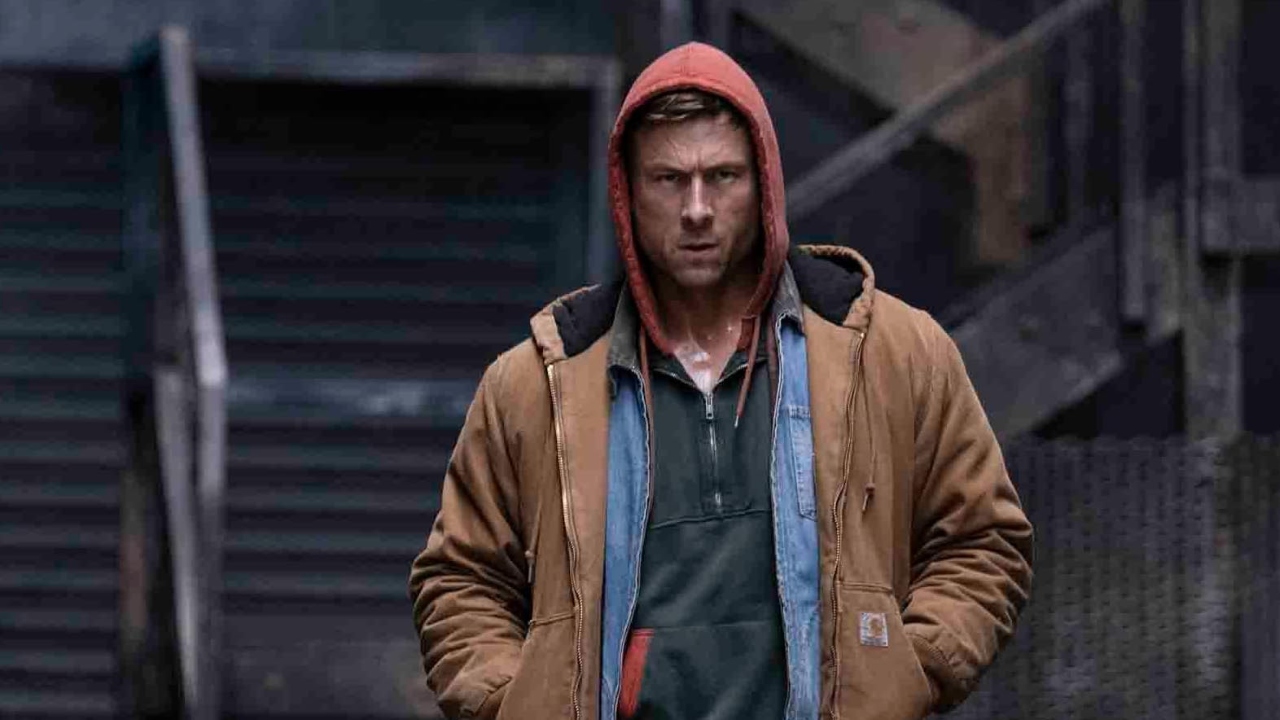
The film notedly takes Ben Richards back to being just an ordinary man struggling for financial survival rather than casting the part with Arnold Schwarzenegger whose superhuman physique and gaudy opponents made everything into far more of a WWE match. Although even then, Edgar Wright cannot help but sway towards wanting to give this more of an Action Movie emphasis. Glen Powell may be an ordinary average man but when he takes his shirt and even his towel off, he is bulging with muscles and a ripped bod.
Part of Edgar Wright’s problem with the film is that he seems uncertain whether he is conducting a remake of Stephen King’s book or a remake of the 1987 film. Ostensibly this has the intention of doing the former but there are times it cannot help but seem the latter. Glen Powell’s interview with CEO Josh Brolin is peppered with unnecessary flash fantasies where he smashes Brolin’s head into the desk. This becomes particularly evident during the scenes where Glen Powell makes his escape from the hotel where Edgar Wright lets loose on the budding action film he has been holding back. This is at its most ridiculous during the escape from Michael Cera’s place where the house is transformed into an absurd comic-bookish realm of pop-up boobytraps. (At least, an unrecognisable Cera and his mother, played by Sandra Dickinson, once Trillian in tv’s The Hitch Hikers Guide to the Galaxy (1981) who has gotten a lot older in the interim, prove to be the film’s scene-stealers during these scenes).
For a time, The Running Man 2025 doesn’t seem to be have any greater ambition than being a capable action film. There is some of the satiric attack on the media that we get in the 1987 film but not much – perhaps it that the advent of reality tv since 1987 has caused much of the outrageousness to simply fade in and become part of the wallpaper of modern media.
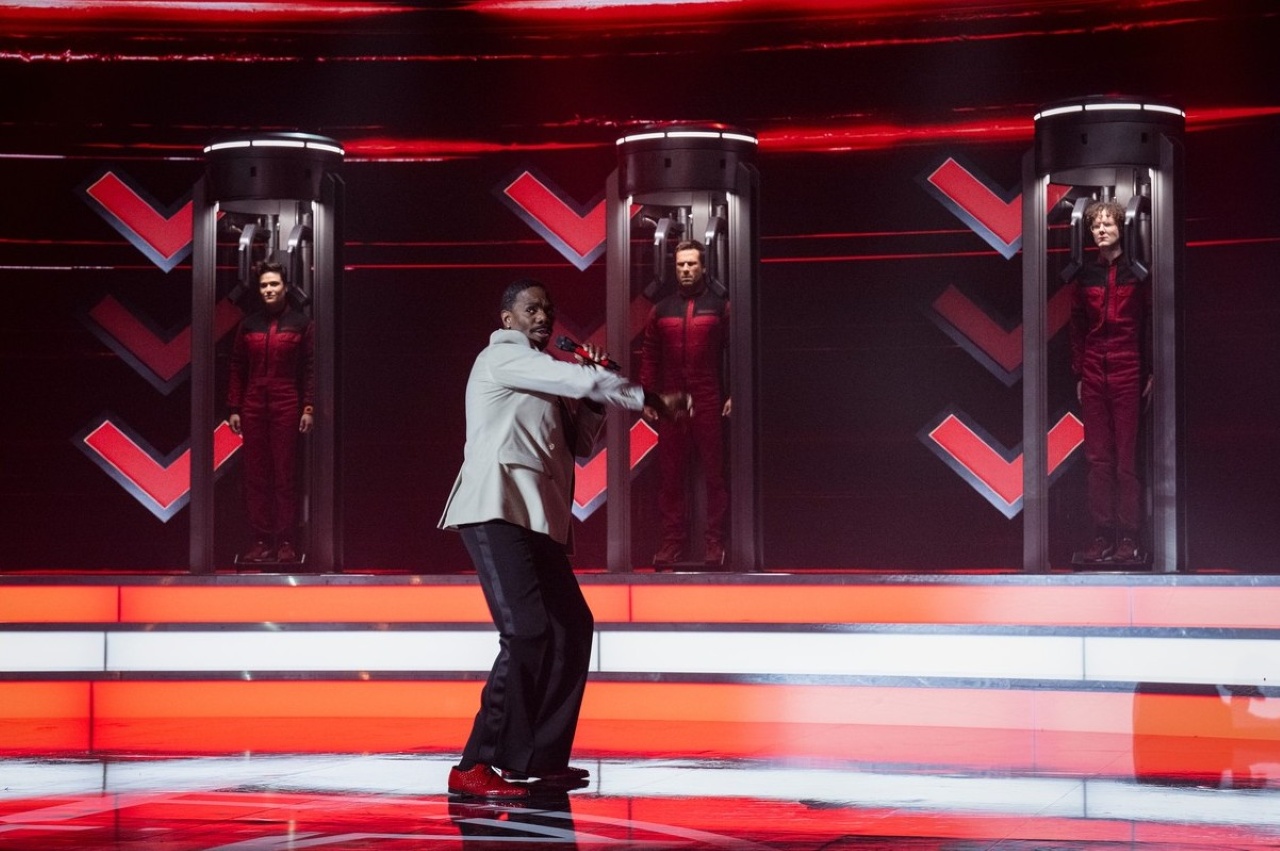
However, as the film goes on, that starts to change, and increasingly Wright begins to make a series of digs at modern USA and society. The masked Hunters striding in slow-motion (in one scene in particular with the American flag rippling behind them) have unmistakeable overtones of associations with Trump’s ICE agents. Just like the modern era, the film sees the big media and government have become collaborative entities to create propagandist images – here the line is blurred altogether where, the show’s killers seem interchangeable with media security and government agents, while we are told that The President himself will come to confirm Ben as the head of the new show. Much is made out of the ability of tv to edit and twist facts – Ben sends out a message but this is replaced by an edited version that paints him as a villain. Much more is made of the one-man revolutionary movement headed by Michael Cera than King ever had it. One of the most hilarious lines is when Glen Powell and Emilia Jones are apprehended by a local militia who proclaim “We’re here securing our homestead in the name of the Network” – here even the survivalists who defy federal government have been coopted by the media.
The climax of the show is the most interesting and potently satirical aspect of the film and where this version really comes into its own. Wright has Glen Powell and Emilia Jones [PLOT SPOILERS] board the plane and scenes where Powell is stage managed into a confrontation by killing McClone and the pilots of the plane (as happens in the King novel) by being told his wife and child have been killed, all to provide a dramatic climax for the tv show. Thereafter things diverge where Powell goes to fly the plane into the tv station hq and delivers a blistering attack on the system, only for this to be substituted with a deepfake by Brolin. It is the amusing moment where we see that the reach of tv’s alteration of reality has become such that a typical Arnold Schwarzenegger-esque defiance of the system is replaced by the fake.
[PLOT SPOILERS CONTINUE] In the subsequent scenes, we see that Richards has survived. However, all of this is amusingly presented blogger style in the exact same tones adopted by conspiracy theorists. Here the message seems to be not so much a defiance of the system as in that the side that wins is the one that has the best propaganda or presentation of reality – here the truth has to fight on the same ground as the system’s lie. Although rather than end at such a very 2020s satiric point, the film goes out with a more traditional heroic comeuppance where Glen Powell returns to confront Josh Brolin’s CEO.
Other Stephen King genre adaptations include:- Carrie (1976), Salem’s Lot (1979), The Shining (1980), Christine (1983), Cujo (1983), The Dead Zone (1983), Children of the Corn (1984), Firestarter (1984), Cat’s Eye (1985), Silver Bullet (1985), The Running Man (1987), Pet Sematary (1989), Graveyard Shift (1990), It (tv mini-series, 1990), Misery (1990), a segment of Tales from the Darkside: The Movie (1990), Sometimes They Come Back (1991), The Lawnmower Man (1992), The Dark Half (1993), Needful Things (1993), The Tommyknockers (tv mini-series, 1993), The Stand (tv mini-series, 1994), The Langoliers (tv mini-series, 1995), The Mangler (1995), Thinner (1996), The Night Flier (1997), Quicksilver Highway (1997), The Shining (tv mini-series, 1997), Trucks (1997), Apt Pupil (1998), The Green Mile (1999), The Dead Zone (tv series, 2001-2), Hearts in Atlantis (2001), Carrie (tv mini-series, 2002), Dreamcatcher (2003), Riding the Bullet (2004), ‘Salem’s Lot (tv mini-series, 2004), Secret Window (2004), Desperation (tv mini-series, 2006), Nightmares & Dreamscapes: From the Stories of Stephen King (tv mini-series, 2006), 1408 (2007), The Mist (2007), Children of the Corn (2009), Everything’s Eventual (2009), the tv series Haven (2010-5), Bag of Bones (tv mini-series, 2011), Carrie (2013), Under the Dome (tv series, 2013-5), Big Driver (2014), A Good Marriage (2014), Mercy (2014), Cell (2016), 11.22.63 (tv mini-series, 2016), The Dark Tower (2017), Gerald’s Game (2017), It (2017), The Mist (tv series, 2017), Mr. Mercedes (tv series, 2017-9), 1922 (2017), Castle Rock (tv series, 2018-9), Doctor Sleep (2019), In the Tall Grass (2019), Pet Sematary (2019), The Outsider (tv series, 2020), The Stand (tv mini-series, 2020-1), Chapelwaite (tv series, 2021), Lisey’s Story (tv mini-series, 2021), Firestarter (2022), Mr Harrigan’s Phone (2022), The Boogeyman (2023), The Life of Chuck (2024), Salem’s Lot (2024), the tv series The Institute (2025- ), The Long Walk (2025) and The Monkey (2025). Stephen King had also written a number of original screen works with Creepshow (1982), Golden Years (tv mini-series, 1991), Sleepwalkers (1992), Storm of the Century (tv mini-series, 1999), Rose Red (tv mini-series, 2002) and the tv series Kingdom Hospital (2004), as well as adapted his own works with the screenplays for Cat’s Eye, Silver Bullet, Pet Sematary, The Stand, The Shining, Desperation, Children of the Corn 2009, A Good Marriage, Cell and Lisey’s Story. King also directed one film with Maximum Overdrive (1986). Stephen King on Screen (2022) is a documentary about King film adaptations.
(Nominee for Best Adapted Screenplay at this site’s Best of 2025 Awards).
Trailer here