

Crew
Director/Screenplay – Bret Wood, [Uncredited] Based on the Novella Carmilla (1872) by J. Sheridan Le Fanu, Producers – Christopher Mills & Melissa Palmer, Photography – Chris Tsambis, Music – Paul Mercer, Makeup Effects – Blake Myers & Nick Morgan, Production Design – Laurie Garner. Production Company – Illustrated Films.
Cast
Christen Orr (Carmilla Karnstein), Hannah Fierman (Laura Pickett), William Katt (Troy Pickett), Lynn Talley (Karen Pickett), Kylie Brown (Millarca Karnstein)
Plot
Carmilla Karnstein arrives in New Canaan, North Carolina in search of her mother Millarca. Her search takes her to Millarca’s last known address, but the owner Troy Pickett denies knowing Millarca. Carmilla befriends Troy’s daughter Laura who offers her a place to stay on the property. Laura pushes her father to tell Carmilla the truth about Millarca. He is unwilling to admit that he regarded Millarca as an evil seductress who seduced his wife away from him. Meanwhile, the friendship between Carmilla and Laura develops into the two becoming lovers. Laura begs Carmilla to cut her and drink her blood. Troy becomes fearful that the same will happen to Laura as did his wife.
The novella Carmilla (1972) by Irish author J. Sheridan Le Fanu is one of the prototypic works of vampire fiction. In fact, it predates Bram Stoker’s Dracula (1897) and is noted for creating the archetype of the lesbian vampire. Carmilla has undergone a substantial number of films adaptations. It loosely (to the point of having almost nothing in common) formed the basis of Carl Dryer’s classic Vampyr (1932). The first proper adaptation was Roger Vadim’s Blood and Roses (1960) and this was followed by the Italian-Spanish Terror in the Crypt (1963); Hammer Films’ trilogy consisting of The Vampire Lovers (1970) starring Ingrid Pitt as Carmilla, Lust for a Vampire (1971) with Yutte Stensgaard and Twins of Evil (1971) with twin sisters Mary and Madeline Collinson; the Spanish The Blood-Spattered Bride (1972) starring Alexandra Bastedo; an episode of the tv series Nightmare Classics (1989) starring Meg Tilly; the modernised Styria (2014) starring Julia Pietrucha; and Carmilla (2019) starring Devrim Lingau.
The Unwanted is generally dismissed as an adaptation of Carmilla but I found more interesting than most give it. First of all, it modernises the story to the present day and locates it in North Carolina (in fact, location shooting in Atlanta, Georgia). It does rearrange the story. In the Le Fanu original, Laura is the daughter of a count and remembers a childhood dream of a girl entering her bed. A girl is then brought to the castle after a carriage crash and this turns out to be Carmilla, the girl from Laura’s dream. Carmilla displays romantic interest towards Laura but proves to be a vampire comes to prey on her. It is realised that Carmilla and her ancestor Mircalla Karnstein, who also calls herself Millarca, are one and the same. The story ends as Carmilla is killed by the vampire hunter General Spielsdorf.
The Unwanted has the same basic characters and character names as the story but rearranges them considerably. Now the focus of the story is no longer on Laura and it is Carmilla who becomes the point-of-view character. This Carmilla is searching for her mother Millarca, which brings her to the ranch of Laura’s father (William Katt). Laura is someone who has a troubled history but connects with Carmilla and asks for her to stay on. Carmilla is now not a vampire predator and a much more sympathetic mundane character. Millarca is not another identity that Carmilla adopted but Carmilla’s mother who has gone missing. The two girls are drawn into a lesbian relationship where is it actually Laura who seduces Carmilla.
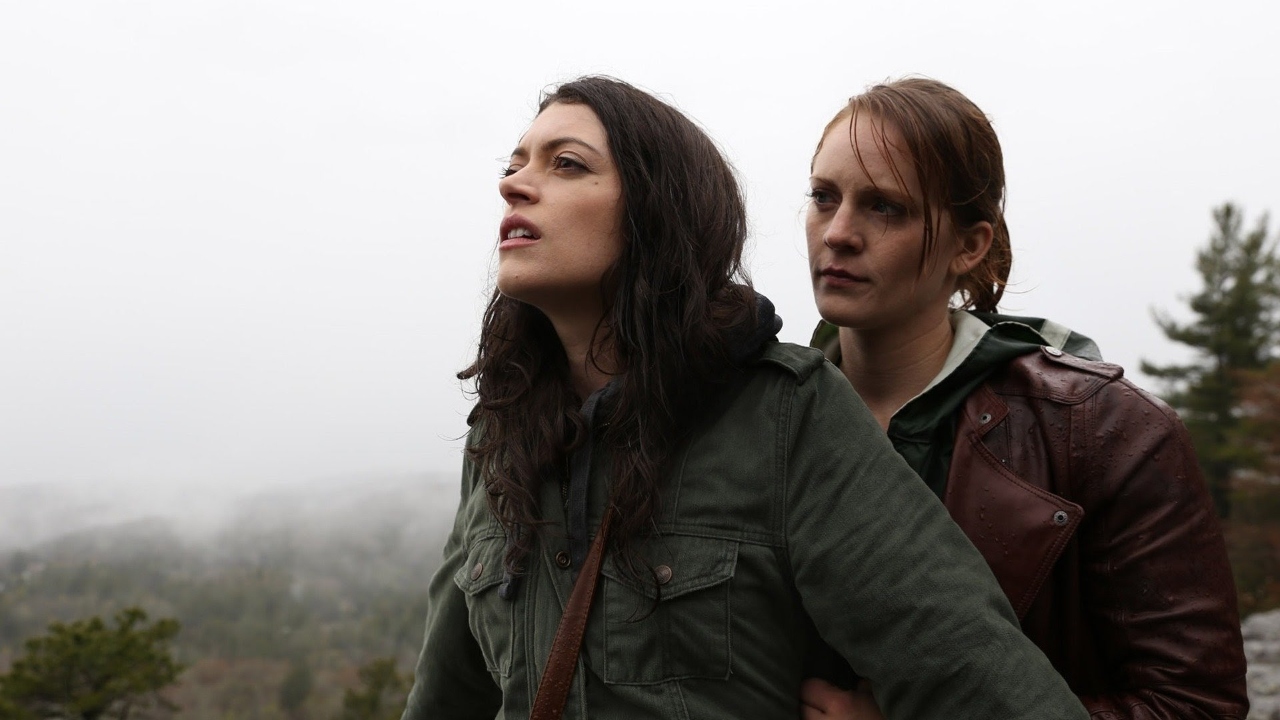
Crucially, The Unwanted no longer appears to be a Vampire Film but a lesbian romance about two girls connecting. This is okay, but in having Laura as the party who persuades Carmilla, the sympathies of the story seem off. Carmilla is the more confidant character in the story and, as in Le Fanu and all the other film versions, is the dominant one is the relationship.
There is an element of The Ambiguously Fantastic present in the film where Hannah Fierman’s Laura urges Christen Orr’s Carmilla to drink her blood. Here however we get no sense of this being vampirism and that it is more to do with Laura’s penchant for cutting and that she obtains sexual pleasure from such. We even see Carmilla trying to persuade Laura not to cut. There are flashback scenes to Mircalla (Kylie Brown) seducing Laura’s mother (Lynn Talley) and the ambiguous suggestion that she may have wielded some power over her. But that is it in terms of any vampirism or any element of the fantastic in the story.
There is also no General Spielsdorf in the story. Now the equivalent is played by Laura’s father (William Katt), who becomes the villain at the end seeking to stake Carmilla, believing her to be a witch. Here the film cleverly winds its ambiguity around to suggest that the idea of any vampire (or witch) is all in the mind of William Katt who cannot handle the thought of his wife being seduced away from him and came to believe it was due to evil influence. This is in essence the basic character of Lincoln Maazel’s Tati Cuda in Martin (1976), the original and cleverest of the psychologically ambiguous vampire films.
Elsewhere, director Bret Wood has made the horror documentaries Lon Chaney: Behind the Mask (1996) and Kingdom of Shadows (1998), the psycho-sexual films Psychopathia Sexualis (2006) and The Little Death (2010), and the horror film Those Who Deserve to Die (2019). In addition, Wood has also produced a great many genre documentary films as accompanying dvd extras.
Trailer here